Welcome to another dental discussion, as we are heading into a very busy National Pet Dental Month.
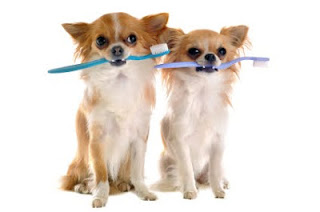 |
Dr Doc and Dr Dean - the tooth brush makes
their teeth sit perfectly! |
For those of you who may stumble on this post in the months/years to come, every August (as it has been for the last 10 years that I can remember, and will be forever more I hope), veterinarians all over Australia, give up their time for FREE to check your pet's mouth. So, if it is March that you are reading this, go to your smart phone's calendar and schedule it in now for next August. Then ring your local vet when that smart phone of yours beeps!
Every vet I know love puppy checkups. I know I do.
I love the puppy breath, the happy waggy tail, I love everything about that first vet check visit...,but every so often, there is a consult where my whole body shakes, and my shoulders slump, and I feel physically sick. This is the consult where I have to tell the puppy owner some bad news.
" Your baby is perfect, but...." I don't deliver bad news well, because I feel the pain of the news too, so acutely.
So what bad news could I deliver about a puppy's mouth that would make me feel sick? They should be perfect, shouldn't they?
Well, I have seen (and treated)
- fractured baby teeth
- No baby teeth at all, or teeth that not erupting well
- extra teeth
- baby teeth which are angled in a way that they hit the gum or roof of the mouth or in other "not normal" directions
just to name a few.
I truly understand it from the owner's point of view - there is a mismatch to the pain I (the vet) know the pet must be feeling, to the pain the pet is telling the owner they are feeling (pets do not seem to tell us that there is pain in their mouths). It can be a confusing time, but remember, I will always be here to help you and your pet.
The examples I use here are from my own case files.... the situations are real, the puppies are real.... (and amazingly awesome, because I was allowed to fix them, and make them pain-free)
 |
The yellow arrow points to the
draining infection - and infection
means pain. |
The most common fractured tooth I see are the canines - whether upper and lower, and unless the puppy is five and half months old, with the adult teeth about to erupt (and even almost then), those baby teeth need to be extracted carefully under general anaesthetic.
The fractured tooth allows bacteria a direct path to the tooth root, and you know the sort of things that puppies love to chew or eat (like their own poo).
The heat generated by this infection can damage the developing enamel on the teeth that we hope the pup will keep until their dying day. The sooner the fractured tooth is extracted, the sooner
the infection is managed.
Do not muck around... extraction is required as soon as the fracture is found. Dealing with an enamel damaged tooth is not easy, so this is a case of prevention is better than cure.
I hear what you are thinking right now - yeah, right, remove a tooth the pup is going to loose in time anyway! You must be joking!
Well, I do like to joke and kid around, I do have a weird sense of humour, but pain and lifelong, permanent damage, and did I mention pain? is not something I make light of - the pup will lose the damaged tooth very soon (in a matter of weeks to months), but the reason for the extraction is to prevent damage to a tooth that we hope the dog will keep for 15 years or more.
As for poorly erupted teeth - well I have seen it in two little shih tzu's where at 12 weeks of age, there were hardly any teeth (which in my view is not normal), but the breeder/owner was adamant that the teeth will come. As I have not seen these dogs as adults, I do not know whether they did eventually erupt.
.
And there are the funky extra baby teeth - such as seeing 8 upper incisors - where the average dog has six upper and lower incisors -- xraying these mouths is essential, as there is no law that says that all of the extra teeth have to be in an area that we can see where they are... that is, there is nothing stopping the mouth having unerupted extra teeth, as well as the extra teeth we see. These usually end up with extra adult teeth too - makes these ones "extra-special".
But the discussion that causes the most distress to the owner, and the multiple phone calls to the breeder, the breeder's vet, which then eventually leads to a confused, scared owner, is the tooth that hits the gum or the roof of the mouth.
And the reason this causes the most stress, is that the best treatment is an immediate anaesthetic to extract the baby tooth, which is not risk free, coupled with strict observation of the mouth whilst the adult teeth are erupting. And in almost every case, intervention is going to be needed in the adult mouth also to make sure that the tooth sits where it is supposed to a swell.
In other words, "your baby is perfect but..... they need an urgent procedure because there is pain in that mouth", and whilst we can do something now to fix the problem, it is probably a temporary thing, and further intervention is going to be needed at six to seven months of age too. The owner sees dollar signs, and the poor vet (me) sees ongoing pain in this mouth, which is fixable and manageable, but involves a committed owner.
This condition is given the name "Base Narrow Canines"... and its proper name (until it gets changed) is Lingually Displaced Mandibular Canines... in other words - "the lower canine decides to head towards the roof of the mouth, punctures into it, instead of deciding to sit in the gap between the upper canine and upper incisor, and clearing the gum totally.".
For me, I will stick with "Base Narrow Canines". This little puppy with the yellow circle was only 12 weeks old when I saw it. It already had its first vet check and vaccination, and was with me for her second vaccination. This puppy was beautiful, and patient with us in taking photos like this.
And sadly, almost all of these puppies need to have an anaesthetic to examine, as virtually all of them are impossible to keep still to examine when they are
 |
An adult dog -
With the mouth closed... ouch!
I never saw this dog as a puppy. |
awake.... and this is because it hurts - they are "head shy".
They eat well, and play with their toys - in fact they usually over - love their toys - because their mouths don't hurt when they eat or play - why? because the tooth tips do not hit the mouth when they are carrying a ball around, nor when they are crunching on food. But they are still in pain.
Treatment needs to be done as soon as the problem is identified, for animal welfare issues alone. Pain and fear imprints on a puppy from 6 weeks to 14 weeks - this is why a well run puppy preschool is an absolute requirement for all puppies - but if there is pain in the mouth, this also imprints on the puppy - they become head shy, and, some, become overly aggressive - understandably so, because it hurts.
The teeth that are hitting soft tissues need to be removed -it could involve just removing the lower canines, or it could be removing all lower and upper incisors, and lower canines. You may be lucky, and all that needs to be removed is a wee bit of gum that causes the "cupping" that locks the tooth in place. Either way, we do not know until the little one is under anaesthetic, and properly assessed.
 |
Ouchy ouch ouch... How can anyone say
this doesn't hurt... have you ever had a
mouth ulcer? It hurts! This dog was young,
we removed the gum, did some ball
exercises and is pain free now. |
If this is the right thing to do to give the pet a pain free mouth, then it needs to be done. I can't change this truth just because no one wants to hear it.
I often hear the argument for cutting the teeth, or waiting and seeing. Cutting the teeth is painful... the thought makes me feel sick - do you know someone who had a tooth fractured from trauma? I do, and it is extremely painful.
Do our pets show dental pain? Most times they don't show it, but they do FEEL dental pain. They have the same nerve endings and have parts in the body that recognise pain - just because they don't show pain, doesn't mean they are not in pain.
. Be mindful of this fact when your awesome vet, wherever they may be, tells you that your pet needs some work - they want your pet to be painfree, like I do.

But, on a happy note - Pet Dental Month is for puppies and kittens too, for all (and more) of the reasons above. So bring your puppy in, so I can get some puppy kisses!
I am Dr Liz, and I am the mad vet from Russell Vale Animal Clinic. I am here to help you always, to keep your pet happy and healthy. Give me a call on 42845988 or you can
book online.


